A Strategic Framework for Facility Managers, Operations Leaders & Business Owners
Commercial cleaning is not a cosmetic function — it is an operational pillar that directly impacts safety, productivity, regulatory compliance, customer perception and the long-term performance of your facility.
A well-maintained environment reduces risk, improves workforce efficiency and strengthens the organization’s professional image. Achieving this level of consistency requires more than basic janitorial routines — it demands technical processes, industry-specific protocols and structured quality control.
1. Start With a Facility-Specific Assessment (Operational Diagnostics)
High-performing facilities begin with a technical evaluation of their environment. This assessment maps:
- Traffic flow and usage patterns
- Material specifications (vinyl, LVT, epoxy, tile, stone)
- IAQ (Indoor Air Quality) risk points
- Sensitive areas and compliance requirements
- Operational hours and disruption tolerances
- Industry standards for sanitation and safety
Be Clean develops a tailored operational blueprint that aligns cleaning schedules, chemical selection, equipment specification and workflow design to the facility’s real operational flow, this ensures cleaning supports — not interrupts — daily operations.
2. Build a Structured Cleaning Cycle (Daily, Weekly, Monthly)
Consistency is the foundation of a high-performing facility. The strongest commercial cleaning programs operate on predictable cycles:
Daily Cycle — Health Protection & First Impressions
- Touchpoint disinfection
- Entry and lobby presentation
- Restroom sanitation
- Breakroom cleaning
- Trash removal
- Light floor maintenance
Daily cleaning preserves hygiene and ensures the building remains presentable at all times.
Weekly Cycle — Deep Maintenance
- High- and low-dust removal
- Restroom deep cleaning
- Workspace detailing
- Wall and partition spot-cleaning
- Interior glass touch-ups
Weekly maintenance “resets” the environment, maintaining sanitary and aesthetic standards.
Monthly Cycle — Systemic Upkeep
- HVAC vent and grille cleaning
- Upholstery sanitation
- Deep floor sanitation and polishing
- Doorframes, high-touch and hard-to-reach cleaning
OSHA highlights that dust accumulation and HVAC contamination significantly impact IAQ (Indoor Air Quality), reinforcing the need for structured dust control and ventilation cleaning.
Be Clean supports facilities across the Greater Michiana Area with cleaning cycles engineered for corporate, industrial, medical, educational and retail environments.
3. Prioritize High-Traffic and High-Visibility Zones
These areas shape the perceived quality of the entire building:
- Entrances and reception
- Hallways and transition areas
- Breakrooms and cafeterias
- Restrooms
- Conference rooms
- Waiting rooms
- Client-facing zones
Maintaining excellence in these points ensures a consistently polished, safe and professional environment.
4. Address Industry-Specific Requirements With Technical Precision
Different sectors demand distinct cleaning protocols:
-
Industrial & Warehousing
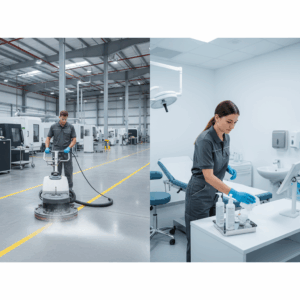
Machine-adjacent dust control, safety line visibility, grease removal, and high-traffic floor sanitation.
-
Medical, Outpatient & Healthcare
Clinical-grade disinfection, contamination control, chemical compliance, and protection of sensitive surfaces.
-
Educational Institutions
Odor mitigation, classroom air quality, high-touch sanitation, and cafeteria/restroom rotation cycles.
EPA and CDC emphasize the importance of air quality and routine HEPA-based filtration in schools.
-
Retail & Dealerships
High-visibility floor care, smudge control on glass and surfaces, display cleaning, and restroom maintenance.
Be Clean builds protocols that align with operational, regulatory and aesthetic standards for each sector.
5. Establish a Structured Communication System
Reliable cleaning depends on reliable communication. Be Clean maintains:
- Immediate issue reporting
- Proactive operational updates
- Leadership-level communication when needed
- Clear logs of completed work
- Fast adjustments for schedule changes
This gives facility managers visibility, control and peace of mind — eliminating surprises and reactive headaches.
6. Implement Quality Control for Long-Term Consistency
High-level facilities require continuous verification. Be Clean integrates:
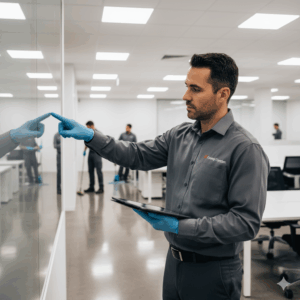
- Scheduled supervisor inspections
- Quality control checklists
- Corrective action protocols
- Performance reviews
- Client feedback loops
- Routine re-training
These processes keep your facility safe, compliant and consistently high-performing. When cleaning is structured and technically precise, it reduces operational friction, strengthens compliance, improves productivity and protects the facility’s brand image.
Ready to elevate the safety, efficiency and performance of your facility?
Schedule a facility assessment and receive a customized commercial cleaning plan engineered around your operational flow, industry standards and compliance requirements.
Our structured systems help organizations reduce risk, improve productivity and maintain a workplace that consistently performs at its best.