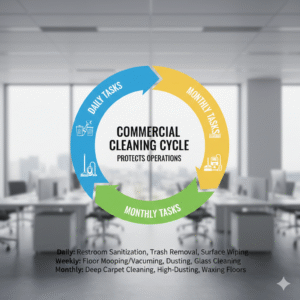
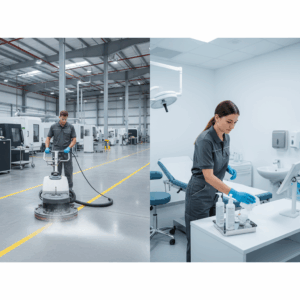
Most facilities don’t struggle because cleaning is “bad.” They struggle because cleaning is unstructured.
When there is no predictable commercial cleaning cycle, the service becomes reactive: missed areas, last-minute corrections, repeated complaints, and extra management time. That hidden friction is operational risk.
The solution is simple (but not simplistic): structured cleaning systems — a clear cycle of daily, weekly, and monthly tasks mapped to your building’s rhythm, traffic patterns, and compliance needs.
Why a Commercial Cleaning Cycle Protects Operations
A commercial cleaning cycle is a preventive system. It protects:
- Safety (slips, restrooms, waste control, walkway clarity);
- Appearance (consistent first impressions for clients, patients, staff);
- Compliance (documented routines, inspections, corrective actions);
- Assets (floors, glass, and surfaces maintained with correct methods).
Manual Blog
If your facility depends on predictable routines, your cleaning must be predictable too.
The Foundation of Structured Cleaning Systems
Strong structured cleaning systems follow three principles:
1) Clean what’s seen first, most often
Entryways, restrooms, reception, corridors, and break rooms create the “clean or not clean” perception fast.
2) Prioritize high-touch and high-risk zones
Handles, switches, shared surfaces, and wet areas need consistent attention.
3) Build cycles that prevent buildup
Daily keeps things stable. Weekly prevents accumulation. Monthly resets and protects finishes.
That is the operational logic behind a commercial cleaning cycle.
Daily Tasks in the Commercial Cleaning Cycle
Daily tasks are non-negotiables. If these fail, the whole program feels unreliable.
A typical daily cycle includes:
- Restroom cleaning and restocking (soap, paper, liners);
- Trash removal and liner replacement;
- High-touch disinfection (handles, switches, shared surfaces);
- Break room quick clean (tables, counters, sink);
- Spot cleaning on glass in high-visibility zones;
- Floor stability in high-traffic areas (vacuum/sweep + spot mop).
Manual Blog
Operational benefit: fewer complaints, fewer interruptions, and less “manager follow-up.”
Weekly Tasks: The Buildup Prevention Layer
Weekly cycles are where structured cleaning systems prove their value. This is the layer that prevents “slow decline.”
Common weekly tasks:
-
- Detailed floor care in broader zones (edges, corners, full mopping as needed);
- Dusting beyond daily touchpoints (reachable surfaces, ledges);
- Interior glass cleaning beyond spot work (doors, partitions, conference rooms);
- Baseboards and visible detail points;
- Break room appliance exterior wipe-down;
- Restroom detail work (fixtures, partitions, and buildup areas).
Operational benefit: reduces deep-clean emergencies and keeps appearance consistent.
Monthly Tasks: Reset, Protect, and Support Compliance
Monthly tasks create long-term stability. They protect finishes, reduce odor risk, and support inspection readiness.
Monthly cycle examples:
- Deep detail of corners, behind doors, low-traffic accumulation points;
- Higher dust zones where accessible (vents/fixtures within scope);
- Floor protection steps when appropriate to surface type;
- Glass detailing on frames and less visible partitions;
- Targeted detailing on cabinet fronts/handles and overlooked touch zones.
Operational benefit: fewer “why does it feel dirty?” moments — and fewer costly recoveries later.
How to Build a Commercial Cleaning Cycle Without Friction
If you’re a Facility Manager or Business Owner, here’s the structure that works:
1) Start with a walkthrough (not a template)
Your commercial cleaning cycle must reflect how your facility actually runs.
2) Define scope by area (and write it down)
Reception ≠ warehouse. Restrooms ≠ private offices. Structured cleaning systems are area-based, not generic.
3) Set clear frequencies and sequencing
Daily, weekly, monthly tasks must be assigned intentionally — and in the right order — so the cycle stays stable.
4) Add quality control so “clean” isn’t subjective.
Professional programs include:
- Supervisory reviews;
- Documentation;
- Corrective action loops.
Manual Blog
5) Make communication part of the system
Who approves changes? What’s the response time? Where are issues documented? Predictability reduces operational drag.
Red Flags Your “Cleaning Plan” Isn’t a Real Cycle
You may not have a commercial cleaning cycle if:
- Complaints repeat weekly;
- The building looks clean only right after service;
- Different crews deliver different results;
- No one can explain what’s weekly vs monthly;
- There is no inspection or corrective loop.
These are symptoms of missing structured cleaning systems.
FAQ: Commercial Cleaning Cycle and Structured Cleaning Systems
What is a commercial cleaning cycle?
A commercial cleaning cycle is a structured schedule of daily, weekly, and monthly cleaning tasks designed to keep safety, appearance, and compliance consistent.
Why do structured cleaning systems reduce complaints?
Because tasks are defined by area, frequency, and standard—so cleaning outcomes don’t depend on interpretation or memory.
How do I choose which tasks are daily vs weekly?
Daily tasks protect hygiene and high-traffic perception zones. Weekly prevents buildup. Monthly resets and protects finishes.
Do small offices need a monthly cycle?
Yes. Even small spaces accumulate dust, buildup, and wear. Monthly cycles prevent decline and reduce the need for expensive deep cleans.
What should be documented in the cleaning program?
Scope by area, frequencies, sequencing, methods for surfaces, and quality control expectations (inspections + corrective actions).
A commercial cleaning cycle isn’t “more cleaning” — it’s a structured cleaning system that protects your operation with predictable daily, weekly, and monthly routines.
If you’re a Facility Manager or Business Owner in the Greater Michiana Area (IN & MI), the fastest way to reduce complaints, prevent buildup, and stay inspection-ready is to put your cleaning on a documented cycle — scope by area, defined frequencies, and quality control you can verify.
Ready to upgrade your commercial cleaning program?
Request a custom commercial cleaning quote and a structured cleaning cycle built for your facility.
📍 Be Clean provides commercial cleaning services and post-construction cleaning across South Bend, Mishawaka, Elkhart, Goshen, Granger, Niles, Michigan City, and surrounding communities — delivering consistent results with on-site walkthroughs, customized checklists, and proactive communication.